Decision Intelligence 4 Health (di4health)
A project of TEAM Public Health
Embedded in all journeys (life, learning, strategy, innovation, etc.) are the choices we make. Decision making is our most important daily activity. Annie Duke says it best:1 2 3
“… there are only two things that determine how your life turns out: luck and the quality of your decisions. You have control over only one of those two things.”
“… your decision-making is the single most important thing you have control over that will help you achieve your goals.”
Annie Duke, How to Decide: Simple Tools for Making Better Choices. Penguin Publishing Group, 2020.
In spite of its importance, decision quality is rarely taught formally. This is a shame! Some of reasons include the organizational and analytical complexity of decision making. Figure 1 depicts how decision professionals tackle and manage these two dimensions. To address analytical complexity, this site focuses on decision modeling (aka, decision analysis) using popular data science programming languages such as Julia, Python, and R.
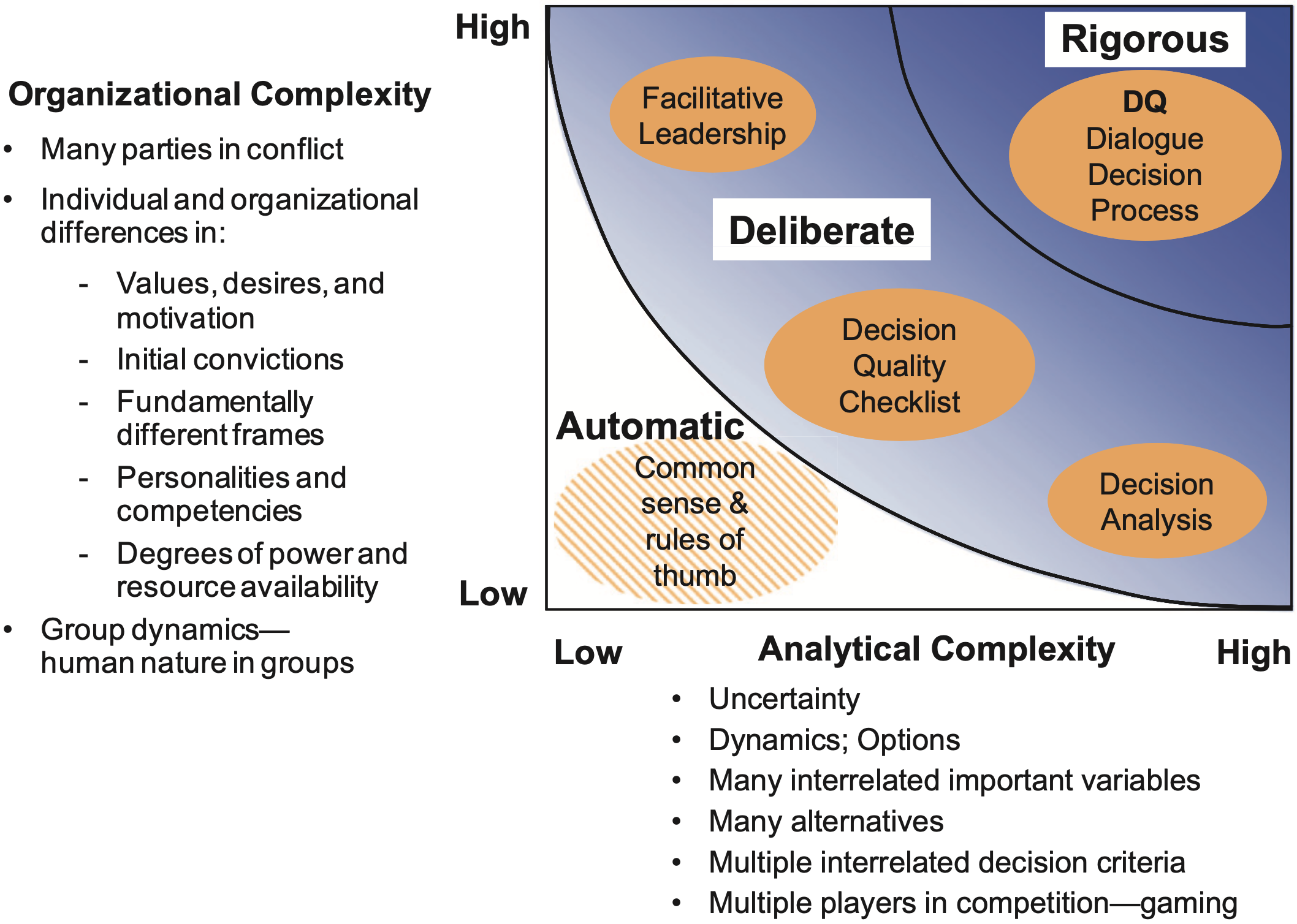
The three dimensions of decision competence are Context complexity, Analytical complexity, and Content complexity (Figure Figure 1). Content complexity covers subject matter expertise and experience. This dimension is foundational and often sufficient for many decisions. This explains why many SMEs are never trained in the decision sciences—being an expert can get you very far. However, to improve our decision making we develop our skills in the other two dimensions.
Context complexity includes:
- Individual and group differences in:
- Values, desires, and motivation
- Fundamentally different frames
- Personalities and competencies
- Degrees of power and resource availability
- Group dynamics—human nature in groups
- Many parties in conflict
Analytical complexity includes:
- Uncertainty
- Dynamics; Options
- Multiple competing objectives
- Many possible alternatives
- Many possible consequences (outcomes)
- Multiple actors in competition (game theory)
The di4health framework
The di4health framework is a holistic, practiced-based framework for team decision making under real world constraints.
Figure 2 depicts the Decision Intelligence 4 Health framework with four pillars:
- 4 dimensions (real world practice),
- 4 competency domains,
- 4 constraints, and
- 4 StEEP decision challenges.
In health and human services, we face 4 StEEP decision challenges:
- St — Strategic decision-making under uncertainty and competition (information, game theory)
- E — Ethical decision-making (values, moral trade-offs, benefits outweigh risks)
- E — Emergency and crisis decision-making (time constraints with high stakes)
- P — Priority setting and resource allocation (resource investment trade-offs)
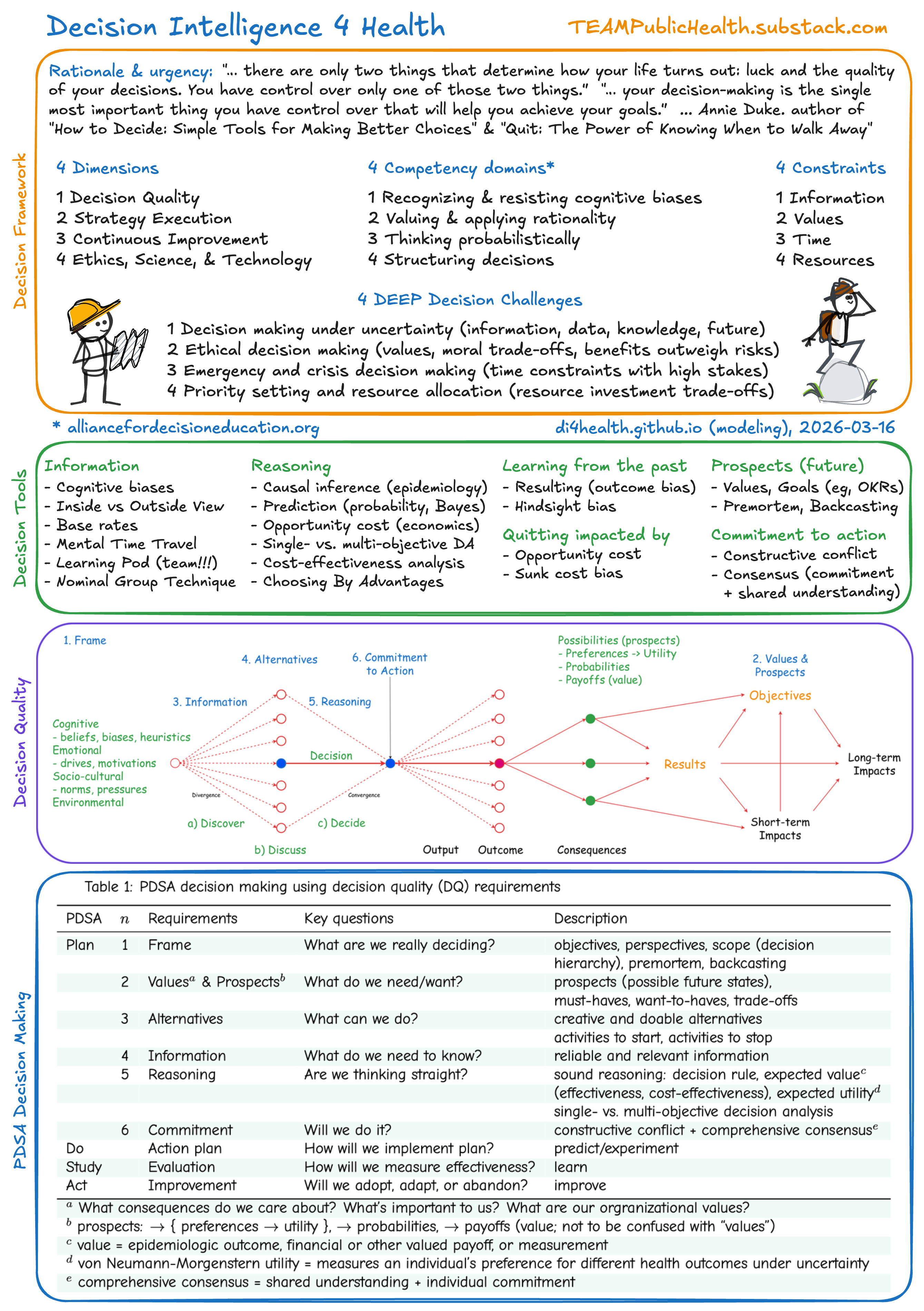
The 4 DEEP decision challenges bring attention for 4 key constraints:
- Information,
- Values,
- Time, and
- Resources.
In practice, these contraints can, and do, occur simultaneously for the DEEP decisions.
Important decisions have 4 dimensions for consideration:
- Decision quality,
- Strategy execution,
- Continuous improvement, and
- Ethics, science, and technology.
In public health, strategic decisions rarely occur in isolation; they often occur within strategic execution frameworks (eg, incident command system, lean management, PDSA/A3 problem solving, needs-driven innovation, Results-Based Accountability). To ensure decision quality, we must deploy continuous improvement, ethics, science, and technology (eg, modeling, artificial intelligence)
Finally, the Alliance for Decision Eduction has developed 4 evidence-based competency domains:
- Recognizing and resisting cognitive biases,
- Valuing and applying rationality,
- Thinking probabilistically, and
- Structuring decisions.
Currently, this site focuses on decision modeling. To learn more about the general aspects of Decision Intelligence 4 Health visit TEAM Public Health:
Decision modeling coding examples
See Decision modeling coding examples (this site)
See Decision Analysis in R for Technologies in Health (external link)
Footnotes
Duke, Annie. How to Decide: Simple Tools for Making Better Choices. Penguin Publishing Group, 2020. https://www.annieduke.com/books/.↩︎
Duke, Annie. Quit: The Power of Knowing When to Walk Away. Ebury Edge, 2023. https://www.annieduke.com/books/.↩︎
Duke, Annie. Thinking in Bets: Making smarter decisions when you don’t have all the facts. Portfolio/ Penguin, 2020. https://www.annieduke.com/books/.↩︎